May 17, 2026
Inner Beauty Cry - Eleonora Kampe
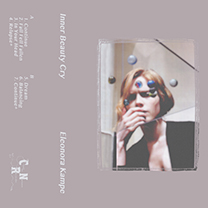 Label: Cruel Nature Records
Catalog #: CN447
Location: Riga, Latvia
Release Date: July 6, 2026
Media: digital download & cassette
bandcamp.com entry
discogs.com entry
The staff of the Poison Pie Publishing House ask up front for the reader to excuse any excessive reverence in this review, but in our defense, the album begins with Eleonora Kampe intoning, "I would like to make a copy of my soul." The invitation to listen to this musical soul-copy arrived in the form of an email carried by electrons. The music itself also bore the form of electrons stored in digital files on a server somewhere on Earth. Because reality does not exist for us outside the form of physical objects, we took it upon ourselves to make an additional copy of this soul by way of a laser altering a layer of photosensitive organic dye on a cdr.
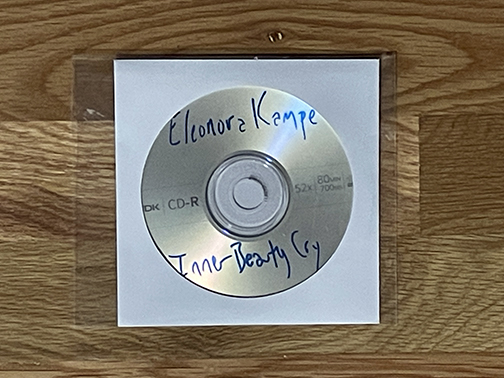
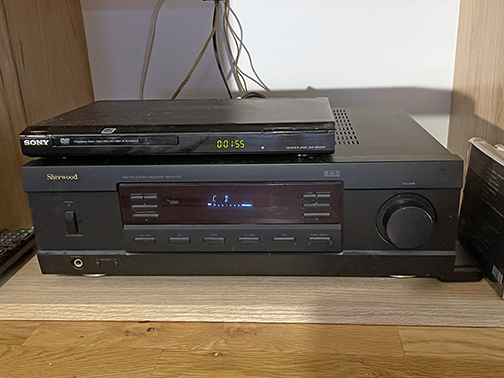
There is a library in the attic of the Poison Pie Publishing House. Earlier this year, we scavenged parts from other rooms in the house to assemble a sound system in the library. Central to the acoustic expression of the soul was a derelict dvd player from a previous era connected to an even older Sherwood tuner manufactured in a time when it was deemed necessary to have an explicit VCR input. The dvd player extracted the information of the soul from the cdr and transmitted it to the receiver, which amplified it.
From the receiver, the soul-copy was transmitted again as electrons along copper wires, originally intended for lighting, to a pair of speakers. One member of the PPPH staff desired a pair of stereo speakers when he was in high school. He worked after school washing dishes at a cafeteria in a shopping mall that has since been demolished as urban blight. Even in the 1980's, one could not afford stereo speakers of any quality on the hourly wages of a part-time dish washer. Thus, he purchased a sheet of plywood, two pairs of three speakers—a tweeter, a woofer, and a mid-range speaker—and a very basic pair of circuit boards, which served as a cross-over, separating input frequencies in to high, low, and whatever fell between. He also purchased black speaker fabric and assembled the speakers. To the best of our recollection, this was likely in 1986. One supposes that the age of this equipment may help it broadcast into the air the emanations of the soul, which we suppose is itself ageless.
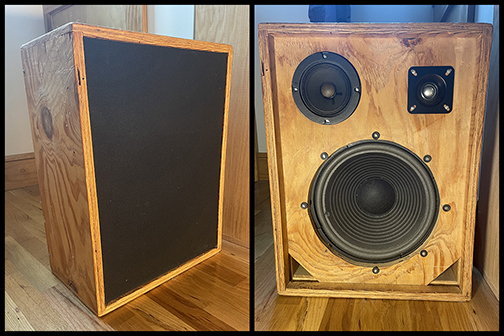
Forty years later, the speakers function, though one deterioated component of the woofers had to be manually replaced about 2010 in a process known as "reconing". From these venerable parts emerged a phrase, "I would like to make a copy of my soul." The sound resonated within angled walls of the attic library.
If readers wonder about the overly lengthy introduction to this review, we simply note that if there is a forty-year history embedded into the music by the listener, how much more relevant is the history embedded in the music by the artist who created it?
We know very little about the history of Eleonora Kampe and next to nothing about life in Riga, Latvia. Consequently, we are obligated to extrapolate what we can from the copy of the music of her soul. Just as the physical world played a significant part for the listener, so must it have played a role for the creator. There must have been a microphone, some ancillary recording equipment, a computer for digital post-processing and multi-tracking. There is also suggested a space where the conception of this work incubated in the mind of the artist. We suppose it had window light, a chair next to a wood-burning stove, to keep warm in the winter. All of this speculation seems at least plausible within the realm of possibilities.
Inner Beauty Cry is a vocal album. The voice is used primarily in a non-verbal mode, although there are a few spoken phrases on the album, most of which are muffled and indecipherable, at least to our ears. The vocals are, we suppose non-idiomatic in form, and manipulated. On a previous release, Balss un rezonanse, Kampe allowed the architecture of the space in which the recording was made to act as an effect on her vocals, but on Inner Beauty Cry we hear the intervention of electronic effects.
One can imagine the tone of vocals that would be appropriate to an album titled Inner Beauty Cry and announced as a copy of a soul. The notion transcends lyrics. Perhaps, one imagines music that could be described with adjectives such as "ethereal" or "other-worldly", given the incorporeal nature of the soul. In parts, the music on the album conforms to this notion. However, this soul is not entirely at peace. On Relapse+, which closes side A, we are made to understand through the emergence of an electronic dissonance that the soul is not wholly free of memories of distress.
Side B begins anew with airy vocals on Dream, but their delicacy is contrasted against brief but harsh intrusions into the dream from (presumably) an external source. The dream is one of a restless sleeper. We don't suppose that gravity interacts with the soul, yet it can fall in response to metaphysical forces. On Balancing, Kampe describes her own individual experience in maintaining a balance within the soul, lest if falter. We found her arguments very persuasive, though we are unlikely to prove successful in duplicating them for our own benefit, as each soul, though cut from the same cloth, is made differently.
Inner Beauty Cry begins and ends with tracks titled Continue and Continue+ respectively, which makes clear that the sonic document in our hands is an excerpt from a larger work, still on-going. While we allowed the universalities contained within the copy of the soul to reach us via old tech, we are interested to hear whether listeners using contemporary technology—cell phones and earbuds—find these sounds of the soul injected directly into their person similarly provocative.
personnel:
